|

Carpal Tunnel Syndrome
Why the Problem May Not Start in the Wrist
Carpal tunnel syndrome is usually spoken about as a wrist problem. The standard explanation is simple enough: the median nerve becomes compressed as it passes through the carpal tunnel at the wrist. This can lead to numbness, tingling, hand pain, weakness, clumsiness, and those unpleasant night-time symptoms that wake people at 3:00 or 4:00 am wondering why their hands have apparently decided to start their own protest movement.
And yes, the wrist matters.

But the wrist may not be the whole story.
At The Spinal Centre, we are far less interested in simply naming a condition and far more interested in understanding why the body is expressing that condition in the first place. With carpal tunnel syndrome, the obvious place to look is the wrist. The more complete place to look is the entire nerve pathway — especially the neck.
The nerves that supply the arms and hands begin in the cervical spine. They exit from the neck, travel through the shoulder and arm, and eventually reach the wrist and hand. If those nerves are already under stress at the neck, they may become more vulnerable to irritation further down the chain. This is the basis of what is known as double crush syndrome.
The idea is clinically important. A nerve that is irritated or compromised in one area — the “first crush” — may be less able to tolerate compression or irritation somewhere else — the “second crush.” In the case of carpal tunnel symptoms, the wrist may be the second crush. The first crush may be occurring much higher up, in the cervical spine.
That is not just theory. A published Chiropractic BioPhysics case report by Pascal Y. Breton, Paul A. Oakley, and Deed E. Harrison examined the complete resolution of carpal tunnel syndrome after improving cervical spine posture. The case involved a 29-year-old male who had been medically diagnosed with carpal tunnel syndrome. He was experiencing bilateral elbow pain and numbness radiating into both hands. His symptoms had become constant over three months and were at their worst between 3:00 and 4:00 am. He had already sought help from multiple healthcare providers, including walk-in clinics, a neurologist, acupuncture, chiropractic care, and pain medication. The relief he received was temporary. The problem remained.
This is a familiar story for many patients. They try brace after brace, rub creams into their wrists, take medication, modify their work setup, shake their hands at night, and hope the issue will disappear. Sometimes it improves. Sometimes it does not. When it does not, the next question must be: what has been missed?
The Missing Link in Carpal Tunnel Syndrome – The Neck
In this case, the missing factor was the Cervical Spine.
Radiographic assessment revealed significant postural distortion, including forward head posture, upper cervical kyphosis, and lateral head translation. In plain English, the patient’s neck alignment was not functioning in a normal structural position. From a neurobiomechanical perspective, this matters. Loss of the normal cervical curve can increase mechanical tension through the spinal canal, placing stress on the cord and nerve roots.
When nerve tissue is already irritated at the neck, even ordinary movements or positions further down the arm may trigger symptoms that appear to be purely wrist-based.
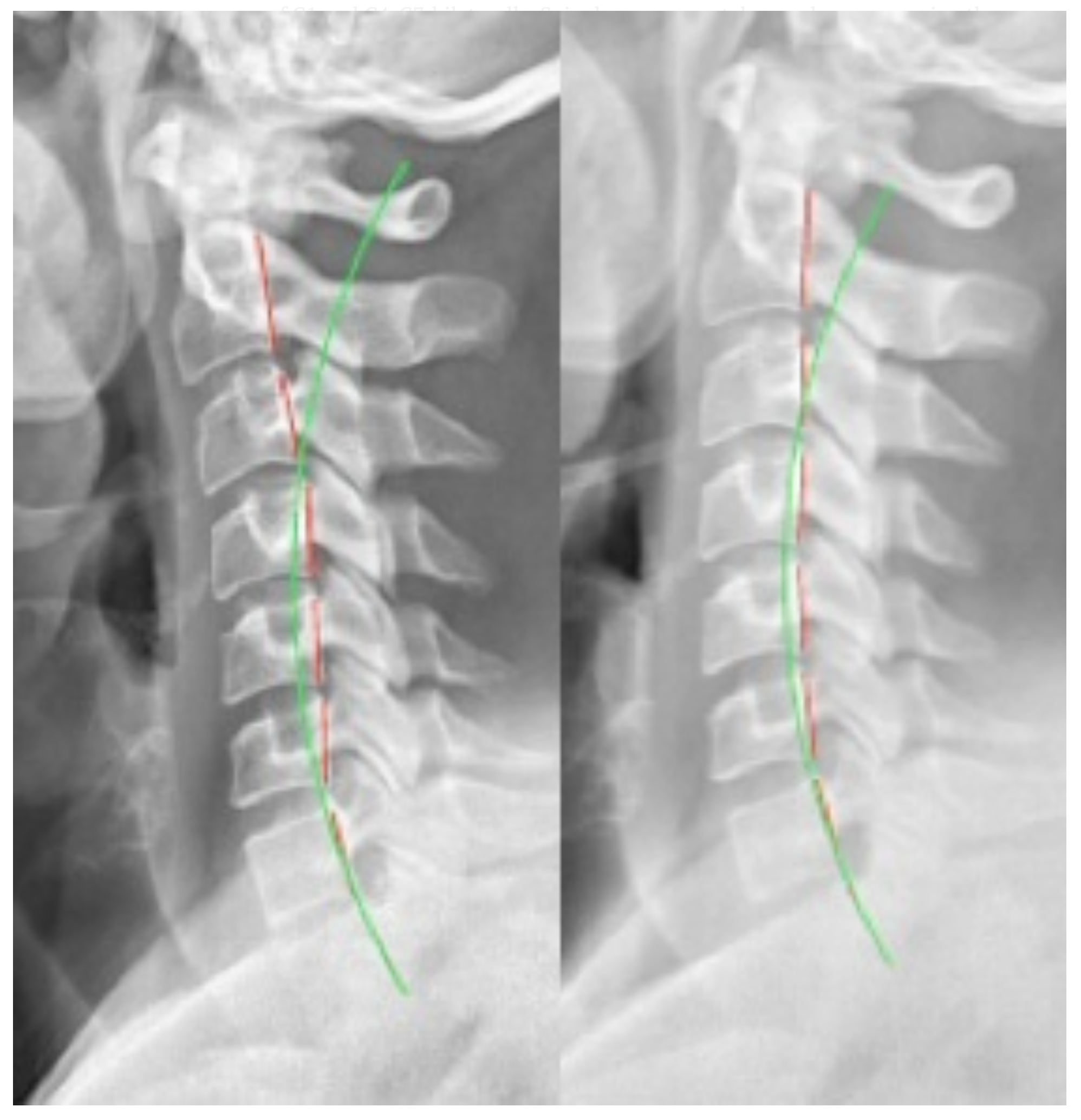
Lateral Cervical Radiographs. Left: Initial view showing cervical kyphosis from C2-C6, and an overall lordosis from C2-C7 of -3.7°. Right: Follow-up view showing reduction of original deformity and an overall lordosis of -18.3°. It’s about Progress – Not Perfection!
The care in the case report was directed at improving cervical spine posture. Care included spinal manipulative therapy, mirror image® corrective exercises, cervical extension traction, upper extremity adjustments, and a daily home rehabilitation routine. Over a 13-week period, the patient completed 33 in-office treatment sessions.
The Results
The outcome was significant. After 13 sessions, the patient reported that he was “feeling great” and back to normal, with no remaining numbness into the hands. After 31 sessions, he reported 100% symptom relief, including no neck pain, no elbow pain, no hand numbness, and no back pain. After 33 sessions, he continued to report no symptoms related to carpal tunnel syndrome.
The structural changes were measurable. His cervical lordosis improved from -3.7° to -18.3°. Forward head translation reduced from 16mm to 5.1mm. Right head shift reduced from 11mm to 5.5mm. In other words, as the neck posture improved, the carpal tunnel symptoms resolved.
Now, let’s be clinically honest. This was a case report. It was one patient. It does not prove that every case of carpal tunnel syndrome begins in the neck. It does not mean every patient with wrist numbness needs the same care plan. Good healthcare does not work that way.
But it does highlight something extremely important: if the cervical spine is not assessed, a major contributor may be overlooked.
This is where corrective chiropractic care becomes so valuable. Corrective care is not simply about chasing symptoms. It is not just about rubbing the sore spot, clicking the noisy joint, or hoping a brace will calm things down. Corrective care asks a better question: what structural and neurological stress patterns are driving the problem?
When a patient presents with carpal tunnel symptoms, the wrist deserves examination. Of course it does. But so does the neck. So does posture. So does the nerve pathway. So does the way the head sits over the shoulders, the way the cervical curve supports the spinal cord, and the way mechanical stress may be affecting neurological function.
Because treating the wrist while ignoring the neck may be like mopping the floor while the tap is still running. Busy? Yes. Productive? Not necessarily.
The Spinal Centre Comment
Carpal tunnel syndrome can be frustrating, limiting, and exhausting. It can interfere with sleep, work, exercise, hobbies, and simple daily tasks. For some people, it becomes a constant background irritation; for others, it becomes a genuine threat to their quality of life.
The good news is that a more tougher assessment may reveal a deeper opportunity for healing – and a better clinical outcome – avoiding dangerous drugs and risky surgery.
If your hands are numb, your wrists ache, or your symptoms keep returning despite treatment, it may be time to look beyond the wrist. The source of the problem may be upstream. And when the source is addressed, the body often has a much better chance to heal, function, and perform the way it was designed to.
We assess the spine, posture, nerve pathways, and structural patterns that may be contributing to your symptoms. Because carpal tunnel syndrome may show up in the hand — but in some cases, the real story begins in the neck.
The Spinal Centre – Neuro-Musculoskeletal SolutionsThe Spinal Centre provides the Best Natural Medicines, Health Products and Nutritional Solutions to Free You of Pain and Improve Your Spinal Health.The Spinal Centre is a leader in the management and treatment of spinal pain and disability including:
- Chronic Back and Neck Pain
- Cervical and Lumbar Disc Injuries with or without neruological changes
- All forms of arthritis including rheumatoid arthritis, psoriatic arthritis and osteoarthritis
- Neurodegenerative diseases such as Parkinson’s and Alzheimer’s disease
- Neuromuscular problems such as chronic back pain, headaches, migraines, neck or spinal pains
- Myofascial pain syndromes such as fibromyalgia, diffuse muscular or joint pains
- Austistic spectrum disorders including ADD, ADHD, learning difficulties and autism
- Fatigue, energy and mood disorders including chronic fatigue and depression
The Spinal Centre focuses on resolution with the development of individualised treatment programs using Conservative and Integrative Medicine; combining genetic, metabolic and nutritional testing with specific natural medicines to enhance your health and achieve your genetic potential.We have helped thousands – Why Not You?